Spatial Audio Formats Explained: Object, Channel, Scene, Binaural
Object-based, channel-based, scene-based and binaural audio, explained in plain words first and in detail after. What each one is, what it isn't, and when it belongs in a project.
After the Dolby Atmos certificate I kept studying other immersive formats on my own. I had done some tests with Ambisonics, but I had never worked with it in a real immersive space.
That changed at Notam, the Norwegian Centre for Technology, Art and Music in Oslo. I had the chance to talk with Thomas Johansen, one of their engineers, about the differences between formats, their advantages and their limits, especially Ambisonics and Dolby Atmos. Ambisonics is his preference, for several reasons. It's open and free to use. It lets you expand the number of speakers as far as the space allows. And it makes it possible to integrate or build dedicated tools around it. Thomas is an engineer, but also a creative and an artist, and that openness matters to someone who builds tools as much as he makes work with them.
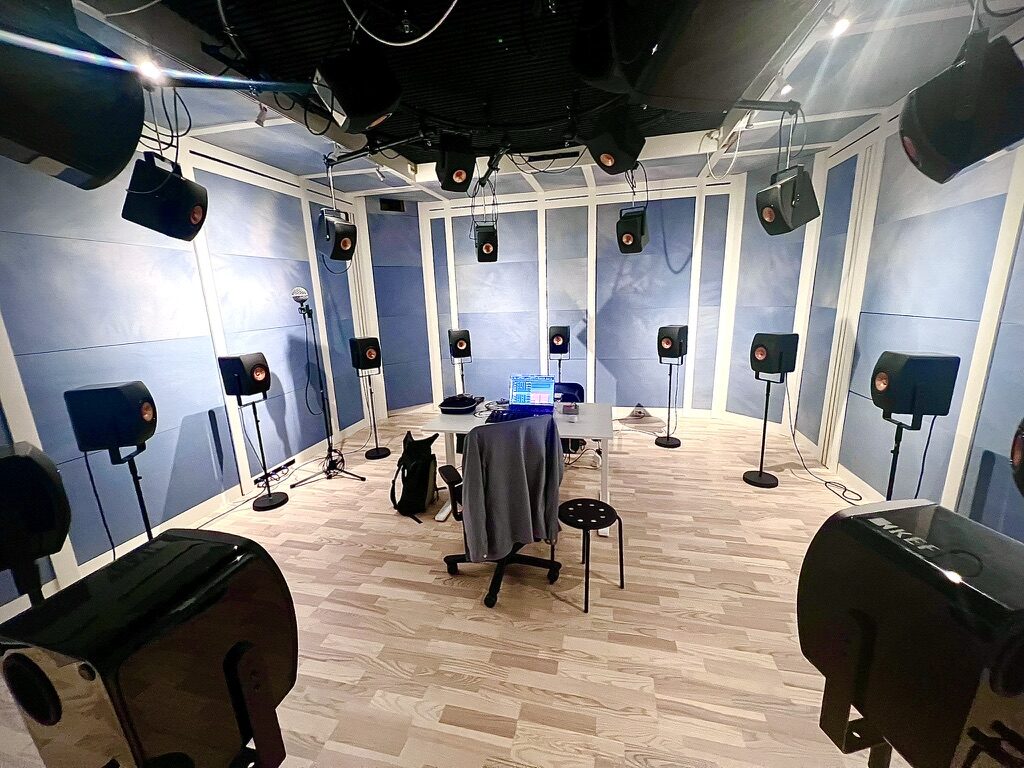
Immersive Studio, Notam, Oslo.
A little later I wrote to Martin Abrahamsen, studio manager and head engineer at Rainbow Studio, in Oslo since 1984. I was in the area, and he said yes with very little notice. While we talked, he showed me the studio, what he was working on, and the tools he builds with AI and how he fits them into his workflow. He was generous with his time, and curious in the way I like, an engineer who builds his own tools instead of waiting for someone else to make them. Among many other things, we talked about his Dolby Atmos system, the format I'm more familiar with. He uses it mainly for music, and for now not that many artists ask for immersive mixes, so expanding the equipment doesn't quite make sense yet. Even so, the system he already has is impressive.
Each use has a different focus, and some people think one format is better than the other, each for their own reasons. For me the interesting part is understanding all of them and learning to use the one a project needs at a given moment. That's why I wrote this.
The four words get mixed up all the time, in forums, in plugin manuals and in conversations: channel-based, object-based, scene-based, binaural. They are not four versions of the same thing. If you choose the wrong one, nothing breaks loudly. The mix just arrives at the listener a little off, and you don't know why.
Plain words first, detail after. If a term is new to you, it links to its entry in the Audio Glossary.
The short version
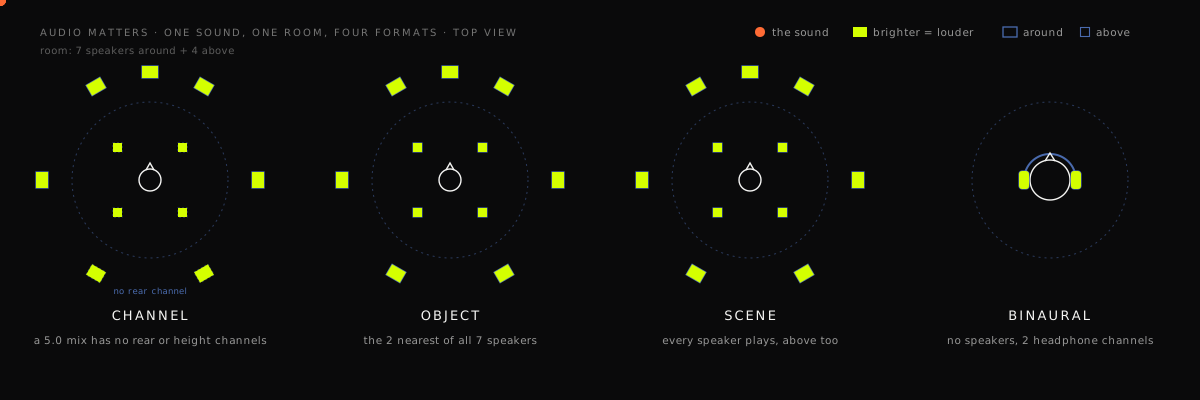
- Channel-based: each channel goes to one speaker. Stereo has 2 channels, 5.1 has 6. The speakers only play the channel they receive. If the room has more or fewer speakers than the mix has channels, the mix has to be converted.
- Object-based: each sound carries its position. No speaker has a fixed channel. The playback system calculates which speakers play each sound, and how loud, using the speakers that are in the room. More speakers give a more precise position.
- Scene-based: records the sound coming from all directions around one point. No channel belongs to a speaker either. A decoder combines all the channels into a signal for each speaker, based on where that speaker is. It works best with speakers spread evenly around the listener.
- Binaural: 2 channels for headphones that make sounds seem to come from around you. It doesn't work on speakers: each ear hears both speakers, and most of the effect is lost.
The first three are ways of building and storing a mix. Binaural is a way of delivering it. That one distinction clears up most of the confusion.
Channel-based audio
In plain words: every channel goes to one speaker in one known place. Stereo is the example everyone knows: left goes to the left speaker, right goes to the right one.
Channel-based audio is the historical default. Stereo, 5.1, 7.1 and the bigger layouts used in cinema and broadcast all work this way. The mix is finished at the moment you export it, and the speaker positions are assumed, not calculated.
That is its strength and its limit. Playback is simple and works everywhere. But if the room has a different layout, the mix has to be squeezed down or spread out (a downmix or an upmix), and something always changes on the way. A 5.1 surround mix cannot become a proper 7.1.4 mix without going back to the session.
You meet it in multichannel WAV stems, Dolby Digital, DTS, broadcast masters, and every stereo master you have ever delivered.
Object-based audio
In plain words: instead of deciding which speaker plays each sound, you describe where the sound is, and the playback system works out the rest.
Object-based audio splits two things that channel-based keeps together: the sound itself and the information about its position. An object is a sound plus metadata (where it is, how it moves, how loud it is). A renderer reads that metadata at playback time and assigns the object to whatever speakers exist in that room, or to headphones.
Dolby Atmos is the example most of us work with. A music master usually combines a bed, which is channel-based and goes up to 7.1.2, with objects that move freely, up to 128 inputs in total. The bed stops at 7.1.2 even in a 7.1.4 or 9.1.6 room. The extra height speakers are reached by the objects. That master travels as an ADM BWF file. It has a .wav extension, but inside it carries the metadata the renderer needs. MPEG-H is the equivalent used in broadcast.
The big advantage: one master serves a soundbar, a 7.1.4 studio, a cinema or a pair of AirPods, each at the quality the hardware allows. The cost: you need a renderer at playback, the files are heavier, and if the metadata is broken the audio is fine but a strict platform can refuse to decode it.
You meet it in Apple Music, Tidal and Amazon Music Atmos releases, Netflix deliveries and modern cinema.
Scene-based audio
In plain words: you record or build the sound that arrives from every direction at one listening point. Later, a decoder converts it to whatever speakers or headphones you have.
Scene-based audio is the family of Ambisonics. It doesn't describe speakers or objects. It describes the sound arriving at one point, split into channels where each one captures sound from a different set of directions.
First-order Ambisonics uses four channels. One works like an omnidirectional microphone and the other three capture front-back, left-right and up-down. Higher orders add more channels and more precision: third order uses 16, seventh order uses 64. The usual convention today is called AmbiX, and it's what YouTube 360 expects.
Because the scene is a field around the listener, rotating it is easy. That's why it pairs so well with head tracking and why it's the standard format for VR and 360 video. The limit is precision. In first order, sounds feel a bit blurry in their position. Higher orders fix that at the cost of many more channels.
You meet it in YouTube 360 videos, VR experiences, and recordings made with soundfield microphones like the Sennheiser Ambeo or the Rode NT-SF1.
Binaural
In plain words: two channels, made for headphones, shaped the way your head and ears would shape a real sound coming from a specific direction.
Binaural is a delivery format for headphones, not a way of building a mix. It works through the HRTF (Head-Related Transfer Function), a measurement of how your head, shoulders and outer ears filter sound depending on where it comes from. Apply that filtering to a sound and your brain places it outside your head.
A binaural file can come from three places. It can be recorded with a dummy head, a microphone shaped like a human head such as the Neumann KU 100. It can be rendered from an object-based mix, which is what happens when you play an Atmos song on headphones. Or it can be decoded from a scene-based recording.
In my Atmos on headphones post I wrote that I'm now convinced I can do almost the whole mix on headphones. Binaural rendering is what makes that possible. It also has a limit worth knowing: the HRTF in the renderer is an average, not your head, so what feels perfectly placed to one person can feel a bit inside the head to another. Head tracking, like Apple's Spatial Audio on AirPods, helps a lot by keeping the sound fixed in the room when you turn your head.
You meet it every time someone listens to an Atmos release on headphones, in VR headsets, and in 360 videos watched without a headset.
Four confusions I keep running into
"Dolby Atmos is a file format." Atmos is an ecosystem: a way of authoring with objects, a renderer and a set of delivery rules. The file most Atmos masters travel in is ADM BWF. And when an Atmos song plays on your phone with headphones, what you hear is a binaural render of it.
"Ambisonics and 360 audio are the same." Ambisonics is the technique. 360 audio is one of the places where it's used. YouTube made them feel like synonyms because its 360 videos use first-order Ambisonics.
"Spatial Audio means Dolby Atmos." Spatial Audio is Apple's name for an experience. It can be an Atmos song rendered to binaural, with or without head tracking, or even a regular stereo song spread around you. Same name, different things underneath.
"Binaural is a 3D file." A binaural WAV is a stereo WAV. The sense of space comes from how the two channels were shaped, not from extra channels. Play it on speakers and most of the effect disappears.
Which one, when
- Music for streaming: stereo channel-based is still the base. Atmos (object-based) is a parallel release, not a replacement.
- Film and series: object-based Atmos for premium delivery, usually with a 5.1 or 7.1 channel-based version alongside.
- VR, 360 video and installations where the listener moves: scene-based, because the point of view changes and the decoder has to follow it.
- Anything heard on headphones: binaural, rendered from one of the other three.
The platform decides the delivery format. What the project will become decides the working format. If you still can't answer "what is going to play this?", it's too early to choose.
If you're an engineer, or an artist
For engineers, nothing here is secret, but it may help you explain to a client why their "Atmos mix" needs a stereo master too, or why the binaural render on their AirPods doesn't sound like your studio.
For artists and producers, you don't need to master the math. Knowing which of the four questions your project is asking is enough to have a much better conversation with whoever mixes it.
Keep going
- LUFS Explorer, to see how loudness normalization works on each platform, Atmos included.
- [A³] Delivery Analyzer, which checks stereo and surround deliveries and the structure of ADM BWF files before you send them.
- Dolby Atmos QC Pack, a delivery guide, wall chart and checklist for Atmos projects.
- Audio Glossary, every term from this post and many more.
Further reading, if you want the depth: Franz Zotter and Matthias Frank, Ambisonics (Springer, 2019). Michael Gerzon, "Periphony: With-Height Sound Reproduction" (Journal of the AES, 1973). ITU-R BS.2051 for speaker layouts and BS.2076 for the Audio Definition Model.
If something here is wrong or unclear, tell me. I'd rather fix it than leave it.
- Andrés 🫀